Can I sell gold without hallmark markings? Yes. A missing stamp does not automatically mean a ring, chain, coin, or other item is fake. Reputable gold buyers can test the metal, estimate its purity, weigh the gold content, and make an offer based on the results. The catch is that you should expect the buyer to verify the piece instead of taking your word for its karat.
Hallmarks are useful clues, but they are not proof by themselves. Marks wear away, clasps get replaced, handmade pieces may never have been stamped, and jewelry made under different rules may use unfamiliar symbols. Fake stamps exist too. What matters at resale is the metal that is actually in the item.
Have Unmarked Gold You Want to Sell?
Tell Cha-Ching Co what you have and request a free cash offer with no obligation.
Can I Sell Gold Without Hallmark Proof?
You can usually sell unmarked gold in the United States as long as you own it and describe it honestly. A buyer may ask for identification, a receipt, or other ownership information, depending on state and local secondhand-dealer rules. Those requirements are separate from whether the jewelry has a purity mark.
In the U.S., familiar markings include 10K, 14K, 18K, 22K, and 24K. You may also see millesimal marks such as 417, 585, 750, 916, or 999. These figures indicate parts of gold per thousand. For example, 585 corresponds to 58.5% gold, which is commonly described as 14K. The Federal Trade Commission's consumer guidance on gold jewelry explains that a karat mark tells buyers how much pure gold a piece is represented to contain. It also advises consumers buying jewelry to look for the maker's name or registered trademark near the karat mark.
That guidance matters when a product is marketed, but a missing mark does not erase the metal's value. A secondhand buyer can evaluate the piece on its actual composition. The offer may be conservative if the buyer cannot test it confidently, so choose a business that explains its process.
Why Genuine Gold May Have No Hallmark
There are several ordinary reasons a real gold item can be unmarked:
- Wear: A shallow stamp inside a ring or near a chain clasp can become faint after years of use, polishing, or resizing.
- Repairs: A replacement clasp, shank, or setting may not carry the mark found on the original part.
- Handmade or older construction: Some artisan, antique, and estate pieces were made without the marks buyers expect today.
- Different marking systems: Jewelry made abroad may have a symbol, maker's punch, or numerical fineness mark instead of a U.S.-style karat stamp.
- Small size: Tiny components may have little practical space for a readable stamp.
There is also a less encouraging possibility: the item may be plated, gold-filled, or made from a base metal. Color alone cannot settle the question. Gold plating can look convincing, and surface wear may be hard to spot without magnification.
How Buyers Test Gold Without a Hallmark
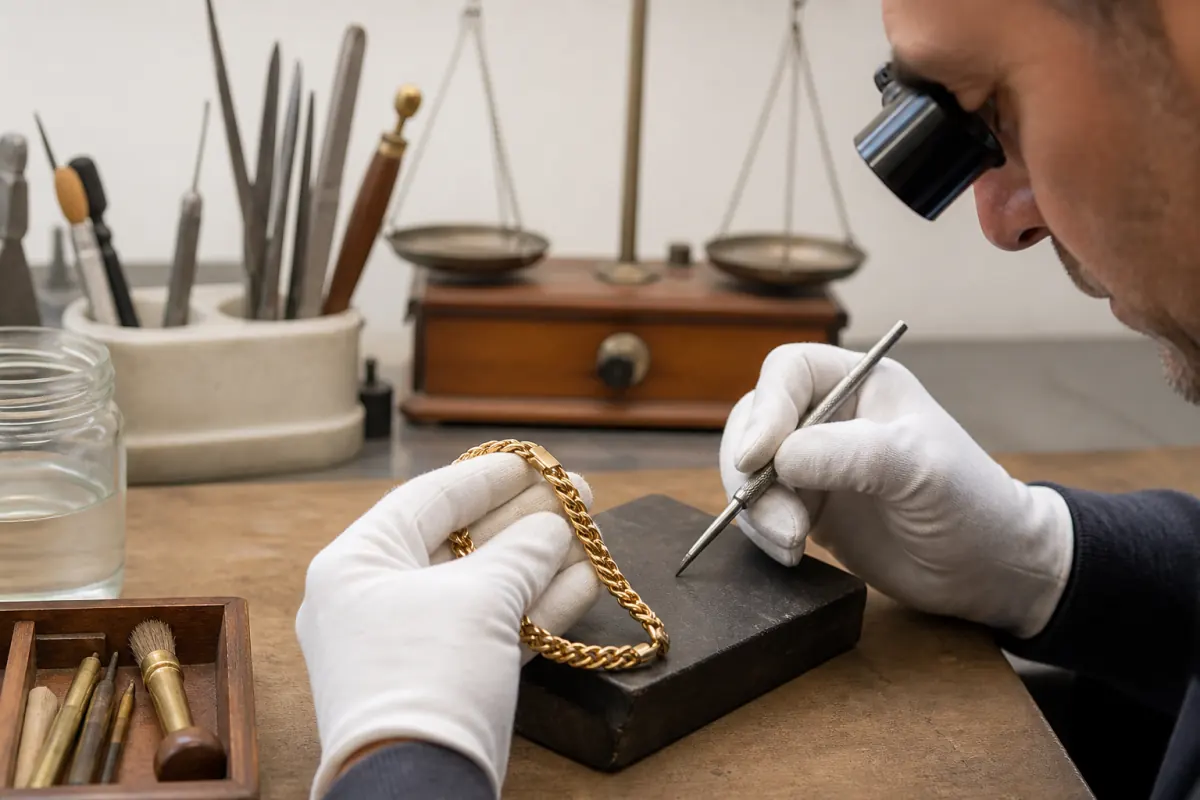
A professional buyer will normally begin with a visual inspection. They may look at seams, worn edges, solder joints, discoloration, and the area around a clasp. A magnet can help identify some base metals, but it cannot prove that an item is gold. Many non-gold metals are not strongly magnetic, and a small magnetic clasp can be attached to genuine gold jewelry.
Touchstone and acid testing
In a touchstone test, the evaluator rubs a small streak of the item on a testing stone and compares how the streak reacts to measured acids. The Gemological Institute of America's touchstone testing guide describes this as a quick, relatively nondestructive way to estimate karat purity. The test should be performed by someone trained to handle the acids safely. It is not a good do-it-yourself experiment at the kitchen table.
A surface test has limits. Heavy plating or an unusual alloy can complicate the reading. A careful buyer may test more than one area, especially when the construction or wear pattern looks inconsistent.
Electronic testing
Electronic gold testers estimate purity by measuring electrical or electrochemical properties. They are fast and useful for screening, but calibration, surface condition, temperature, and plating can affect results. A buyer should confirm questionable readings with another method.
X-ray fluorescence testing
X-ray fluorescence, usually called XRF, analyzes the elements near the surface without cutting or scraping the item. It can provide a detailed composition reading in seconds. It is useful, but it is still a surface-focused method. GIA has documented that plating can sometimes produce a reading that makes an item appear richer in gold than its interior. Experienced evaluators combine the instrument result with inspection and, when needed, another test.
Density and assay methods
Density testing compares an item's weight with the volume of water it displaces. It can support an evaluation of a simple solid object, but hollow jewelry, stones, mixed metals, and trapped air make the result less dependable. Fire assay is much more precise, though it requires removing and melting a sample. It is generally used for refining lots or high-value material rather than an ordinary intact ring.
Get a Straight Answer About Your Gold
Request a free cash offer and decide whether selling makes sense for you.
How an Offer for Unmarked Gold Is Calculated
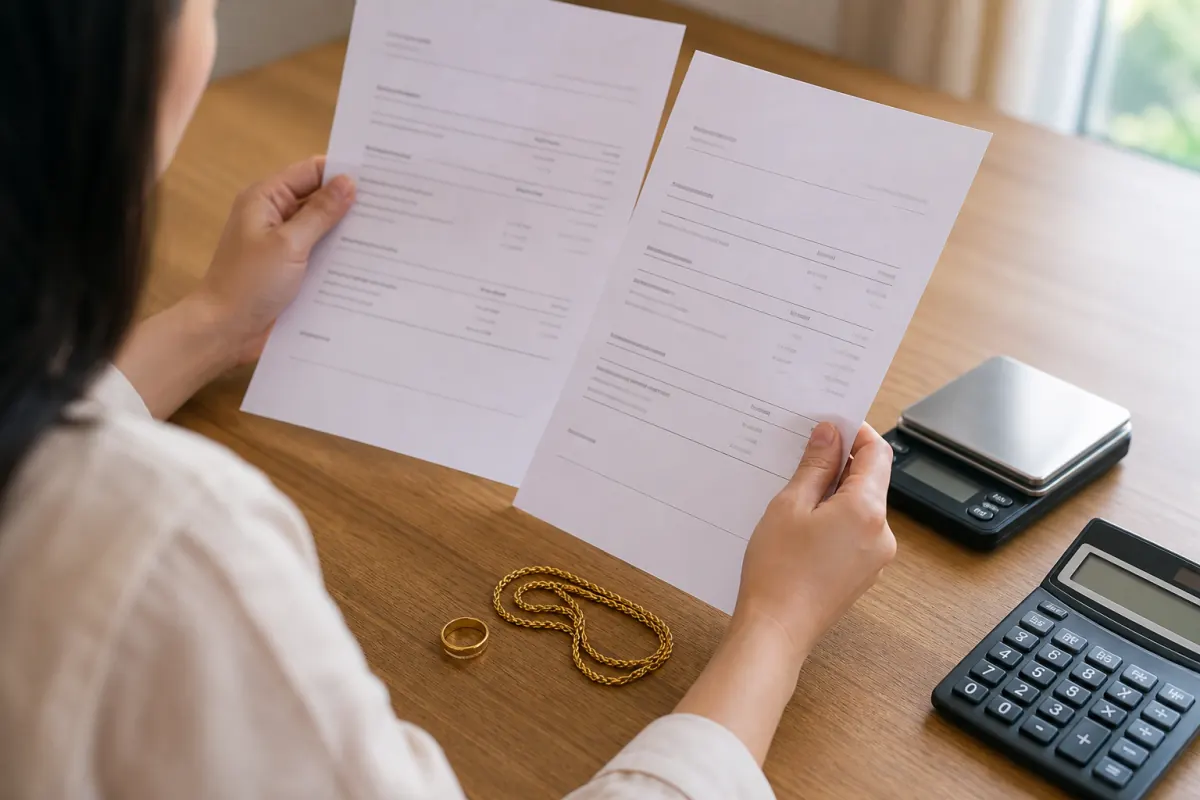
Once the buyer estimates purity, the basic math uses three inputs: the item's weight, its tested gold percentage, and the current market price of pure gold. A 10-gram piece that tests at 14K is not 10 grams of pure gold. Fourteen-karat gold is about 58.3% pure, so the theoretical fine-gold content is roughly 5.83 grams before accounting for stones, springs, solder, or other non-gold parts.
The quoted market price is not the same as the amount a buyer will pay. A buyer has testing, processing, refining, price-risk, and business costs. The spread between melt value and the offer varies. Designer jewelry, collectible coins, and wearable vintage pieces may be worth more than their metal content, while broken mass-market jewelry is often valued mainly for melt.
Ask the buyer to show you the weight, tested purity, market-price reference, and percentage of estimated melt value used for the offer. Our guide to how gold buyers determine value walks through the calculation in more detail. If you are comparing selling options, the guide to selling gold jewelry explains how local buyers, pawn shops, and online services differ.
Can I Sell Gold Without Hallmark Markings for the Same Price?
Possibly, but the answer depends on what testing shows. If an unmarked chain tests consistently as 18K and the buyer is purchasing it for its gold content, the missing stamp should not change the amount of gold in it. The buyer may still build in more caution if the construction is hard to test or the results conflict.
For a branded or antique piece, the absence of marks can affect value beyond the metal. Collectors pay for documented makers, periods, and designs. Aggressive polishing or repairs may remove evidence that supports that premium. Before selling an unusual estate piece for scrap, consider getting a jewelry appraisal from someone who does not also want to buy it.
How to Prepare Before You Visit a Gold Buyer
- Do not scratch or acid-test it yourself. You could damage a collectible finish, stone, or delicate setting.
- Gather whatever history you have. A receipt, appraisal, box, repair record, or family note may help identify the item. It is not required for the metal to be tested.
- Separate obvious categories. Keep pieces marked 10K, 14K, gold-filled, or sterling apart, but let the buyer verify every group.
- Remove nothing permanently. Do not pry out stones or cut apart jewelry just to weigh it.
- Get more than one quote. Compare the net amount you would actually receive, not a vague promise about paying the "highest price."
Photograph the item before handing it over or mailing it. For an online sale, read the return policy, insurance terms, and deadline for rejecting an offer. For an in-person sale, ask whether testing happens where you can watch and whether any test will leave a mark.
Red Flags When Selling Unhallmarked Gold
Walk away if a buyer refuses to tell you the weight or purity result, pressures you to accept immediately, or will not explain deductions. Be cautious if the scale is hidden from view, the unit of measurement is unclear, or several different pieces are lumped together without testing.
Also question any evaluator who treats a stamp as final proof. A fake 18K mark does not turn plated metal into solid gold. On the other hand, someone who declares an unmarked piece worthless without testing may not be giving it a fair evaluation.
Check recent reviews and complaint patterns, confirm the business address, and keep written records of the quote. If the piece may be especially valuable, pay for an independent appraisal before accepting a melt-value offer.
The Bottom Line
You can sell gold without a hallmark. The buyer will need to determine what the item contains, and the quality of that testing matters. A worn or missing stamp is not a verdict. Treat it as a reason to ask for a clear evaluation, watch the weighing process, and compare offers.
If the item tests as genuine gold, its purity and fine-gold weight drive the basic melt value. Age, maker, design, stones, and condition may add value, so do not rush an unusual piece straight into the scrap pile.
Ready to See What Your Gold Could Be Worth?
Ask Cha-Ching Co for a free cash offer. You can review it before deciding what to do.
Disclaimer: This article provides general educational information and is not legal, financial, tax, or appraisal advice. Precious-metal values, buyer policies, and state or local requirements vary. Confirm testing results and transaction terms with qualified professionals before selling.