If you have wondered how do gold buyers determine value, the short answer is that they estimate the amount of pure gold in your item, multiply it by a current gold price, and then subtract the costs and margin required to buy, test, process, and resell it. A fair offer should be explainable. You should be able to see the weight, purity, reference price, and payout percentage before deciding whether to sell.
Get a No-Pressure Cash Offer
See what Cha-Ching Co may pay for your gold, then compare the number with other written offers.
How Do Gold Buyers Determine Value From Weight and Purity?
Most ordinary gold jewelry is first valued for its melt value. That means the buyer is estimating how much pure gold could be recovered from the piece. Three numbers drive the calculation:
- The item's weight, usually measured in grams or pennyweights
- Its tested gold purity
- The buyer's current price for pure gold
Jewelry is rarely pure gold. The Federal Trade Commission explains that 24-karat gold is pure gold, while an 18K piece contains 18 parts gold and six parts other metal. A 14K item contains 14 parts gold out of 24. Those alloys make jewelry harder, but they also mean the full weight is not gold.
The basic purity factors are 10K = 10/24, 14K = 14/24, 18K = 18/24, and 22K = 22/24. In percentage terms, that is about 41.7%, 58.3%, 75%, and 91.7% gold. A "585" mark usually corresponds to 14K, while "750" usually corresponds to 18K. Hallmarks are a starting point, not the final test.
Suppose a 14K chain weighs 20 grams. Its estimated pure-gold content is:
20 grams x 14/24 = 11.67 grams of pure gold
The buyer then multiplies 11.67 grams by the reference value of pure gold per gram. That result is the theoretical melt value before deductions. It is not automatically the amount you will be offered.
How Do Gold Buyers Determine Value Using the Spot Price?
Gold is quoted in financial markets by the troy ounce. A troy ounce equals about 31.1035 grams and is heavier than the 28.35-gram household ounce. Confusing the two can throw off your estimate, so use grams or troy ounces consistently.
Professional market participants may reference benchmarks such as the LBMA Gold Price or live wholesale quotes. A local buyer may update its board once or several times during the day. Ask which price and timestamp the buyer is using. Gold can move between the time you check a phone app and the time an offer is written.
To estimate the pure-gold value per gram, divide a per-troy-ounce price by 31.1035. For example, if pure gold were quoted at $3,000 per troy ounce, the pure-gold reference value would be about $96.45 per gram. This is only an example, not today's price.
Using the 20-gram 14K chain above:
- Estimated pure gold: 11.67 grams
- Example pure-gold value: $96.45 per gram
- Estimated melt value: about $1,125
A transparent buyer can walk you through similar math in front of you. If you want to estimate the number before visiting a shop, our guide to how much gold buyers pay per gram explains the unit conversions and payout calculation.
Why the Offer Is Lower Than the Melt Value
A buyer cannot normally pay 100% of theoretical melt value and stay in business. The item may need to be tested, insured, shipped, sorted, refined, and held while prices change. Refiners may charge fees or settle based on the amount of metal recovered. The buyer also needs a margin for labor, overhead, fraud risk, and profit.
The difference between melt value and the offer is often described as the buyer's spread. There is no single required payout percentage for every item or business. Larger, easily verified bullion products may receive offers closer to wholesale value than a mixed bag of damaged, soldered, plated, or stone-set jewelry.
Ask for both the dollar offer and the percentage of calculated melt value. If the melt value is $1,125 and the offer is $844, the payout is about 75% of melt. That comparison is more useful than a vague promise to pay "top dollar." Our breakdown of what percentage gold buyers take shows how to compare the spread without guessing.
Compare the Math, Not the Sales Pitch
Request a free Cha-Ching Co offer and ask for the weight, purity, and payout to be shown clearly.
How Buyers Test Gold Purity
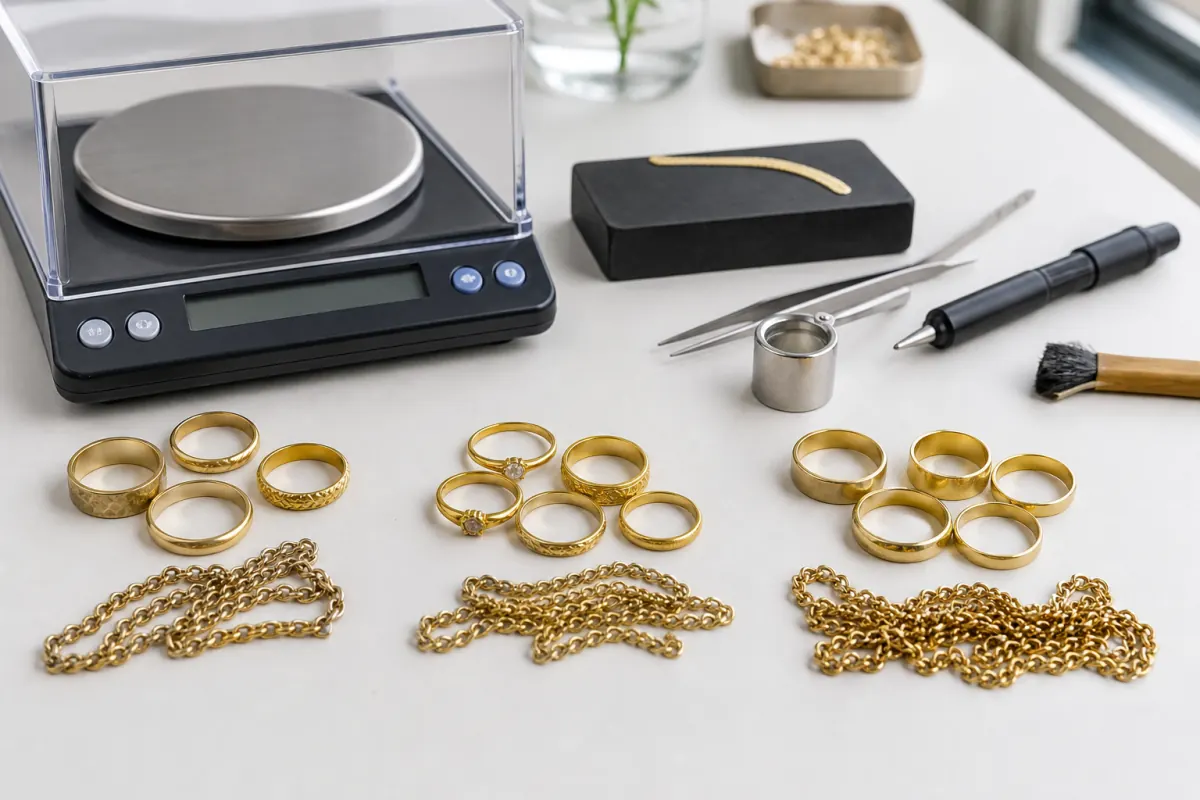
A stamp alone does not prove purity. Clasps can be replaced, chains can contain solder, and plated items can carry misleading marks. Reputable buyers inspect the entire piece and explain any test that may leave a mark.
Visual inspection and hallmarks
The buyer looks for marks such as 10K, 14K, 18K, 417, 585, or 750. The color, wear points, magnetic response, construction, and maker's marks may provide more clues. A magnet cannot prove that an item is gold. It can only help identify some non-gold components.
Touchstone and acid testing
In a touchstone test, the buyer rubs a small streak of metal on a testing stone and compares its reaction to acid with known gold samples. The Gemological Institute of America describes this as a quick, relatively nondestructive method when performed correctly. Acid testing should be done with proper safety equipment, and the buyer should get your permission before filing or notching the item.
Electronic and X-ray fluorescence testing
Electronic testers estimate purity from electrical properties. X-ray fluorescence, often called XRF, analyzes the metal composition without cutting the item. Each method has limits. Surface plating, unusual alloys, solder, or a reading taken from only one area can affect the result. A careful buyer may use more than one test when a reading does not match the hallmark or appearance.
Ask to watch the weighing and testing. The scale should start at zero, and you should be told whether stones, springs, clasps, or non-gold parts are included in the payable weight.
When Gold Jewelry Is Worth More Than Melt Value
Not every piece should go straight to a refiner. Signed designer jewelry, rare coins, antique pieces, collectible watches, and well-made jewelry with valuable stones may have a resale value above their gold content. In those cases, condition, maker, model, age, documentation, demand, and authenticity can matter more than the scale.
Gemstones are usually valued separately. A buyer focused only on scrap gold may offer little or nothing for small stones. Larger diamonds or colored stones may need an independent gemological review. Remember that gemstone carat measures weight, while gold karat measures purity. They are different systems.
Before selling a signed or unusual piece for melt, search the maker and reference number. Gather the box, receipt, appraisal, grading report, and service records. Ask whether the buyer is making a scrap offer or a resale offer. If the piece may be collectible, get an opinion from a jeweler, estate specialist, or auction house that regularly handles that category.
A Fair Gold Offer Should Show These Numbers
You do not need to become a metals trader. You do need enough information to reproduce the offer with a calculator. Ask the buyer to show:
- The gross weight of each purity group
- The tested karat or fineness
- Any deducted weight for stones or non-gold parts
- The gold price used and whether it is per gram or troy ounce
- The estimated melt value
- The final payout and any separate fees
Sorting pieces by purity prevents a low-karat item from pulling down the value of higher-karat jewelry. It also makes competing offers easier to compare. Do not let mixed items disappear into a back room without an itemized receipt or a clear explanation of the process.
How to Compare Gold Buyers Without Feeling Rushed
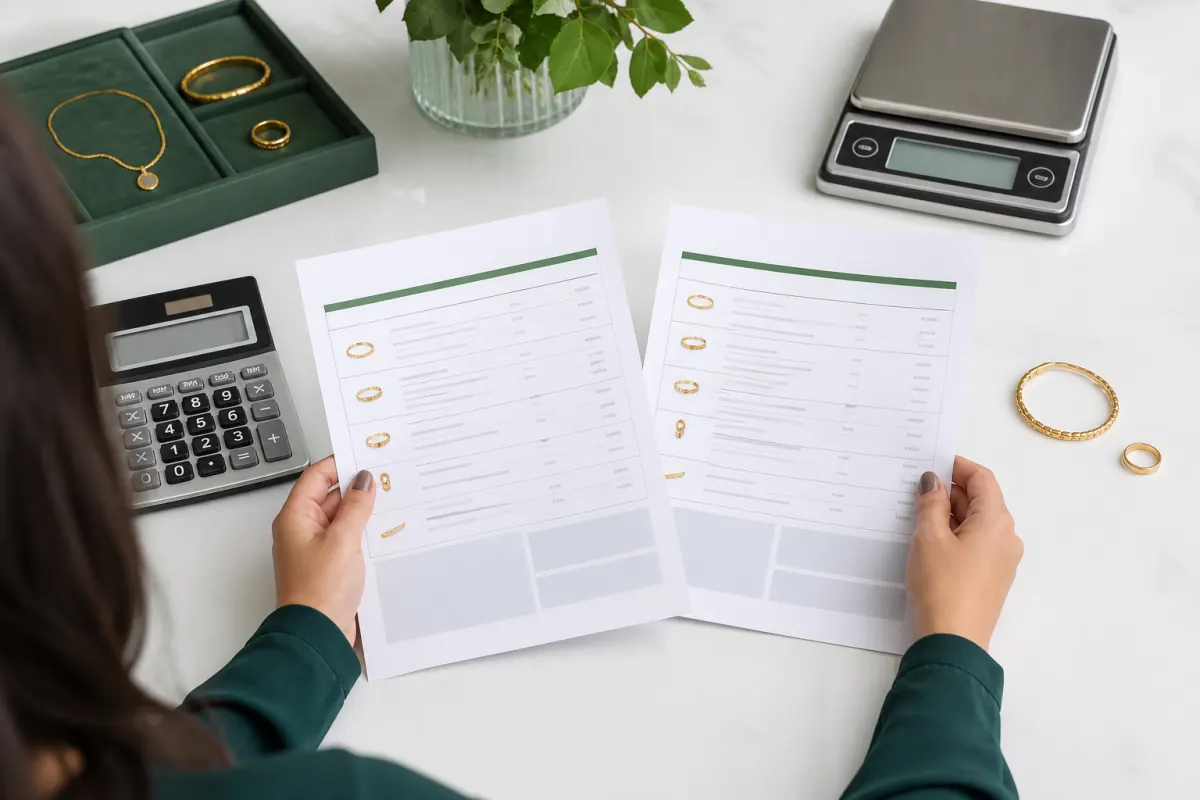
Check the buyer's identity, business address, reviews, and written terms before handing over valuables. Read the cancellation or return policy for mail-in programs. Photograph each item, record visible hallmarks, and keep shipment tracking and insurance records.
Get two or three offers on the same day when practical. Because gold prices move, offers collected weeks apart are harder to compare. Ask each buyer to state how long the quote is valid and whether payment is immediate or issued after a later assay.
Walk away if a buyer will not show the weight, refuses to explain the purity result, changes the quoted unit, pressures you to decide immediately, or asks you to sign a blank form. A legitimate offer can survive a few minutes of questions.
Also pay attention to ownership and reporting rules. Buyers may require government identification and may have to follow state holding-period, recordkeeping, or secondhand-dealer laws. Never sell an item you do not own or have authority to sell.
How Do Gold Buyers Determine Value in One Formula?
For ordinary gold sold for refining, the working estimate is:
Weight x purity factor x pure-gold price per gram x buyer payout percentage = estimated offer
If the piece weighs 20 grams, tests at 14K, pure gold is worth an example $96.45 per gram, and the buyer pays 75% of melt, the estimate is:
20 x 0.5833 x $96.45 x 0.75 = about $844
Real offers can differ because of testing results, excluded parts, market timing, processing costs, and resale potential. Use the formula to ask better questions, not as a guarantee.
See What Your Gold May Be Worth
Get a free cash offer from Cha-Ching Co, review the calculation, and decide on your own schedule.
Disclaimer: This article provides general educational information and is not financial, investment, tax, legal, appraisal, or gemological advice. Gold prices and buyer terms change, and actual value depends on testing and market conditions. Consider an independent appraisal for rare, signed, antique, or gemstone-set pieces before selling.