What percentage do gold buyers take? There is no fixed industry fee, but the gap between your item's melt value and the buyer's offer commonly works out to about 10% to 40%. In other words, many competitive offers land near 60% to 90% of melt value. The exact result depends on purity, weight, testing confidence, refining costs, the type of buyer, and whether the piece has resale value beyond its gold content.
Want a straightforward cash offer?
Tell Cha-Ching Co what you have and get a free cash offer with no obligation.
The phrase "buyers take" can be misleading. Most buyers do not quote a separate commission. They calculate the gold's estimated wholesale value, subtract the amount they need for testing, processing, refining, price risk, and profit, then present the remainder as the offer. That makes the payout percentage the useful number to compare.
What percentage do gold buyers take from melt value?
A fair comparison starts with melt value, not the original retail price. Retail jewelry prices include design, manufacturing, store overhead, marketing, and sometimes a brand premium. A scrap buyer usually cannot recover those costs. The buyer is primarily purchasing the fine gold inside the item.
As a practical comparison range, a seller may encounter offers around:
- 40% to 65% of melt value from a convenience-focused buyer or pawn shop with higher overhead.
- 60% to 80% of melt value from many local jewelry or gold-buying businesses.
- 75% to 90% of melt value from a competitive specialist, refiner-facing buyer, or high-volume service.
These are comparison ranges, not guaranteed rates. A tiny lot may receive a lower percentage because the buyer's handling cost is similar whether the lot is worth $100 or $5,000. Recognizable bullion generally trades closer to the wholesale market than mixed, damaged, or hard-to-test jewelry. A signed designer piece could be worth more as jewelry and should not automatically be sold for scrap.
If one buyer offers $600 for gold with an estimated melt value of $1,000, the payout is 60% and the buyer's gross spread is 40%. That spread is not pure profit. It may cover assay errors, refining loss, shipping, insurance, payroll, rent, and changes in the gold price before the material is sold.
How gold buyers calculate your percentage
The basic calculation is simple:
Weight x purity x current gold value per unit = estimated melt value
Then:
Offer divided by estimated melt value x 100 = payout percentage
Gold is traded in troy ounces, and one troy ounce equals 31.1035 grams. The London Bullion Market Association explains that wholesale gold pricing refers to fine gold content, while fineness describes the proportion of gold in the material. This is why a buyer must adjust the scale weight for purity before applying a market price.
The Federal Trade Commission's guide to gold jewelry explains that 24K is pure gold under the karat system, while 18K contains 18 parts gold out of 24 and 14K contains 14 parts gold out of 24. The LBMA's explanation of gold purity also shows how karat values correspond to fineness. That converts to roughly:
- 10K: 41.7% gold
- 14K: 58.3% gold, commonly marked 585
- 18K: 75% gold, commonly marked 750
- 22K: 91.7% gold, commonly marked 916
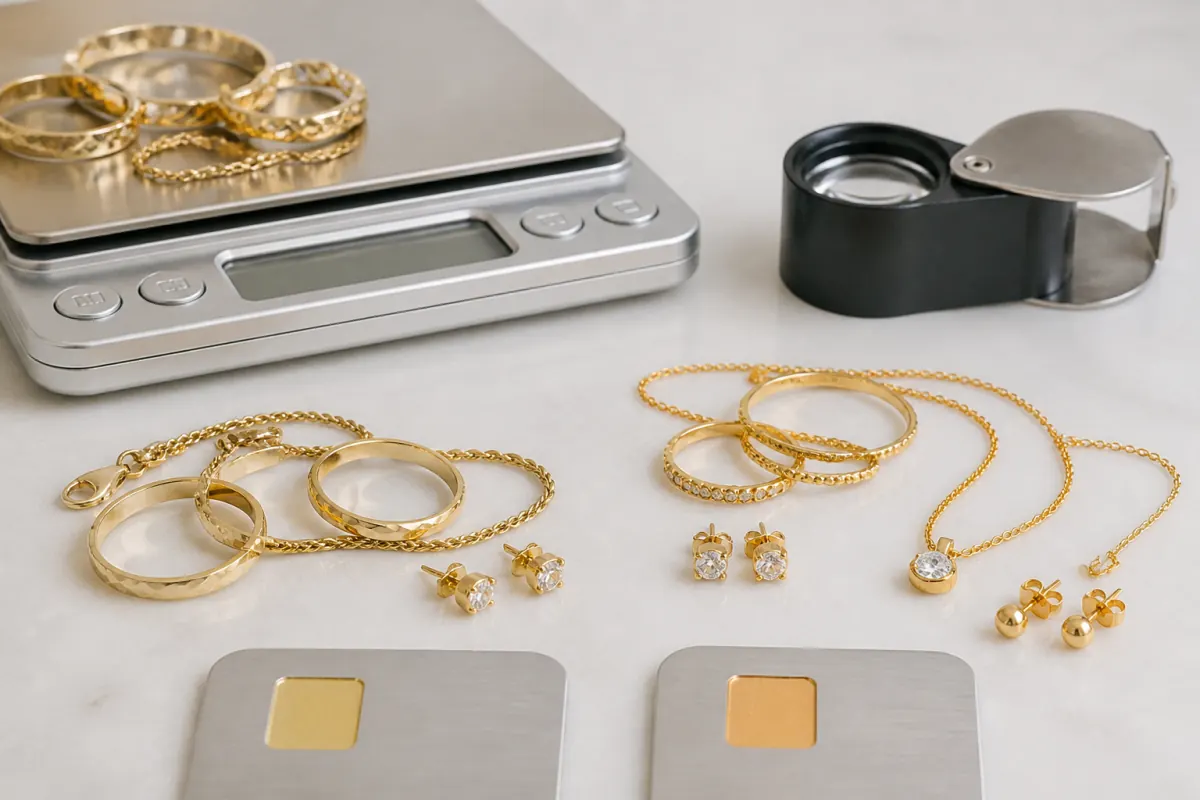
Example: a 14K gold bracelet
Suppose a bracelet weighs 20 grams and tests as 14K. For an easy example, assume the current pure-gold value is $100 per gram. This is sample math, not today's market quote.
- 20 grams x 0.583 purity = 11.66 grams of fine gold.
- 11.66 grams x $100 = $1,166 estimated melt value.
- An $816 offer divided by $1,166 = a 70% payout.
In that example, the buyer's gross spread is $350, or 30%. If another verified buyer offers $933, that is an 80% payout. Comparing offers against the same melt-value estimate makes the difference obvious.
For a more detailed walk-through using grams, see our guide to how much gold buyers pay per gram.
Compare your options before you sell
A free Cha-Ching Co offer gives you another number to compare with your melt-value estimate.
Why two gold buyers can quote different amounts
Two honest buyers can reach different offers because their costs and sales channels differ. One may send scrap to a third-party refiner and pay fees on small lots. Another may aggregate enough material to negotiate better refining terms. A jewelry store may recognize that a piece can be resold intact, while a scrap-only buyer values only the metal.
Testing can also change the number. A hallmark is helpful, but it is not always conclusive. Solder, repairs, clasps, stones, and non-gold components affect payable weight. The Gemological Institute of America describes touchstone acid testing as a quick, relatively nondestructive method. X-ray fluorescence and fire assay are other methods used for more exact analysis. Ask the buyer what method was used and whether stones or other parts were deducted from the scale weight.
Timing matters too. A buyer may lock a price when the item is received, when testing is finished, or when you accept the offer. Find out which price point applies, especially for mail-in transactions.
What percentage do gold buyers take in fees?
Many buyers advertise "no fees" while building their margin into the offer. That is not automatically a problem, but it means you should judge the final payout rather than the fee label. Ask for an itemized explanation of:
- The measured weight and unit used
- The tested karat or fineness
- The reference gold price and time
- Any deduction for stones, clasps, refining, shipping, or insurance
- The final cash amount and whether it can change
Be careful if a buyer quotes only "price per pennyweight" without explaining purity, or weighs an item where you cannot see the display. One pennyweight equals 1.555 grams, so switching units can make an offer harder to check. Convert every quote to the same unit before comparing it.
How to tell if a gold offer is fair
Start by separating pieces by karat mark. Weigh each group on a reasonably accurate gram scale, then look up a current benchmark price from a recognized precious-metals source. Calculate the theoretical fine-gold value. Your home estimate will not replace professional testing, but it gives you a useful baseline.
Next, get at least two written offers. Ask each buyer to show the tested purity and payable weight. Divide each offer by your melt-value estimate. A buyer offering $720 against an estimated $900 melt value is paying 80%. A $540 offer is paying 60%. The dollar difference matters more than a claim such as "top prices paid."
Do not overlook resale value. Fine watches, signed jewelry, collectible coins, and well-made pieces may deserve an appraisal from someone who understands that market. Melting a desirable piece destroys the value attached to its maker, condition, or rarity.
Red flags that matter more than the percentage
A high advertised percentage means little if the buyer uses the wrong purity or quietly deducts too much weight. Watch the scale and confirm whether it is set to grams, pennyweights, or troy ounces. Ask the buyer to test different-karat pieces separately. Combining 10K and 18K jewelry in one lot can hide how each item was valued.
Pressure is another warning sign. You should have time to understand the calculation and leave with your property if the offer does not work for you. For a mail-in buyer, read the return policy before shipping. Confirm who pays return postage, how quickly you must reject an offer, and what happens if the package is lost. Photograph the pieces and record their weights before sending them.
Be skeptical of a buyer who refuses to state the tested purity, payable weight, or total offer in writing. Also avoid anyone who asks you to misdescribe an item or sign an incomplete form. A lower but transparent offer is easier to evaluate than a large verbal promise that changes after the buyer has your gold.
Questions to ask before accepting an offer
- What purity did the item test at, and how was it tested?
- What net weight are you paying for after deductions?
- Which gold price did you use?
- What percentage of estimated melt value does this offer represent?
- Are there mailing, assay, refining, cancellation, or return fees?
- How long do I have to reject the offer and get my items back?
If you are deciding between a collateral loan and an outright sale, our pawn shop vs. gold buyer comparison explains the practical differences.
The bottom line on gold buyer percentages
Gold buyers often retain a gross spread of roughly 10% to 40% of melt value, leaving the seller with about 60% to 90%. Small or difficult lots may fall below that range, while easy-to-trade bullion can sell closer to market value. No single percentage proves an offer is fair. The cleanest test is to verify weight and purity, calculate melt value with a current benchmark, and compare multiple written offers on the same basis.
Ready to see what your gold may be worth?
Request a free cash offer from Cha-Ching Co. There is no obligation to accept.
Disclaimer: This article is for general educational purposes only and is not financial, legal, tax, appraisal, or investment advice. Gold prices, testing results, buyer terms, and offers change. Verify current prices and obtain independent professional advice when appropriate before selling valuable property.