If you are learning how to weigh gold jewelry before selling it, a small gram scale and a few careful notes can give you a useful starting point. The number on the scale is not the same as a cash offer, though. Karat purity, stones, clasps, hollow parts, buyer fees, and the live gold price all affect the final amount. This guide shows you how to record a clean gross weight, convert common units, and avoid calculations that make jewelry look more valuable than it really is.
Want a number to compare?
Request a free cash offer from Cha-Ching Co, then compare it with your own estimate and other written offers.
How to weigh gold jewelry at home
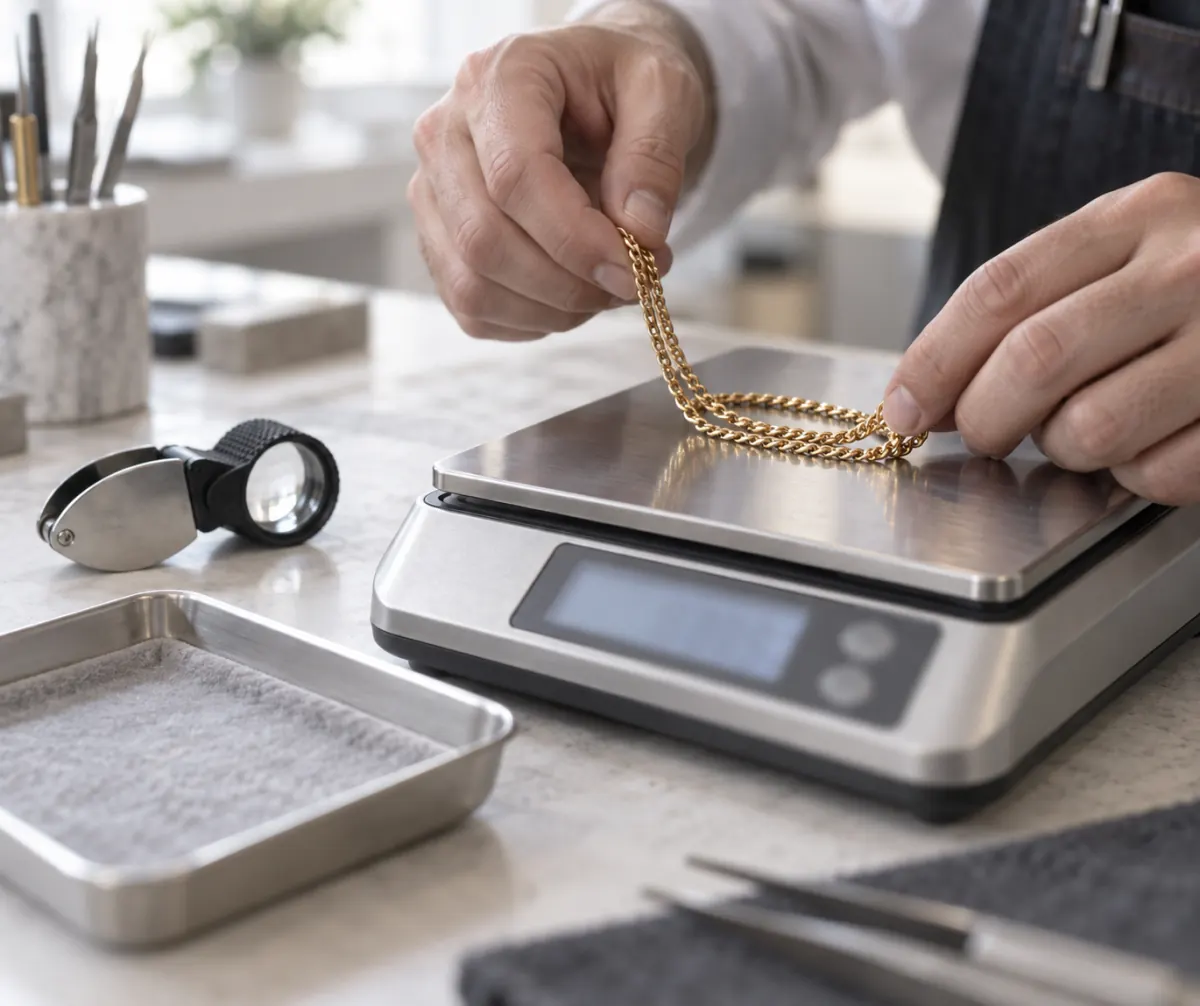
You do not need a jeweler's bench to get a basic weight. You do need a scale that reads in grams, a stable surface, and enough patience to separate unlike pieces. Choose a device intended for small items rather than assuming a household scale will give a useful jewelry reading. Treat the result as a home estimate, not a certified measurement.
- Set the scale on a hard, level surface. Carpet, a soft table mat, vibration, and moving air can disturb a small reading.
- Turn it on and select grams. Gold buyers may quote pennyweights or troy ounces, but grams are simple to record and convert.
- Place an empty tray on the scale and press tare. The display should return to zero. This removes the tray's weight from the reading.
- Add one piece or one sorted group. Wait until the number stops changing, then write it down. Photographing the display can prevent transcription mistakes.
- Repeat the reading. Remove the jewelry, confirm the scale returns to zero, and weigh it again. A different result means you should check the surface, batteries, calibration, or capacity.
Label every home reading as gross weight when the jewelry still contains stones, pearls, enamel, watch movements, steel springs, or other non-gold material. Do not pry out stones or cut a piece apart just to improve an estimate. That can damage jewelry that may be worth more intact.
What kind of scale should you use?
A compact jewelry or pocket scale is usually a practical choice. Read the manufacturer's instructions, stay within the listed capacity, and remember that the tray still counts toward the load even when its displayed weight has been tared away.
If the scale includes a calibration procedure, follow the manufacturer's directions. Weighing the same item more than once is a simple consistency check, but matching readings do not prove that a home scale is accurate. For a sale that depends on weight, ask to see the buyer's scale and testing process.
Bathroom and luggage scales are designed for much heavier objects, so they are poor choices for a light ring or chain. Whatever device you use, record only what it displays and avoid presenting the number as more certain than a home measurement can be.
How to weigh gold jewelry by karat
Sort first, weigh second. A mixed pile may include 10K, 14K, 18K, gold-filled, plated, and unmarked pieces. Combining them into one total makes a useful purity calculation impossible.
Use a loupe and check clasps, inside ring bands, earring posts, bracelet ends, and the backs of pendants. You may see a karat designation such as 10K, 14K, 18K, or 22K. A mark is a clue, not a laboratory result. It may be worn, incomplete, attached to only one part, or counterfeit.
The current Federal Trade Commission Jewelry Guides say it is unfair or deceptive to misrepresent the quantity or karat fineness of gold. They also give examples such as "14 Karat Gold" and explain that hollow gold should be disclosed rather than described as solid. Marks such as GP, GEP, GF, RGP, HGE, and "gold filled" describe coated products, not a piece made throughout from the stated gold alloy. Keep those items separate from solid-karat jewelry.
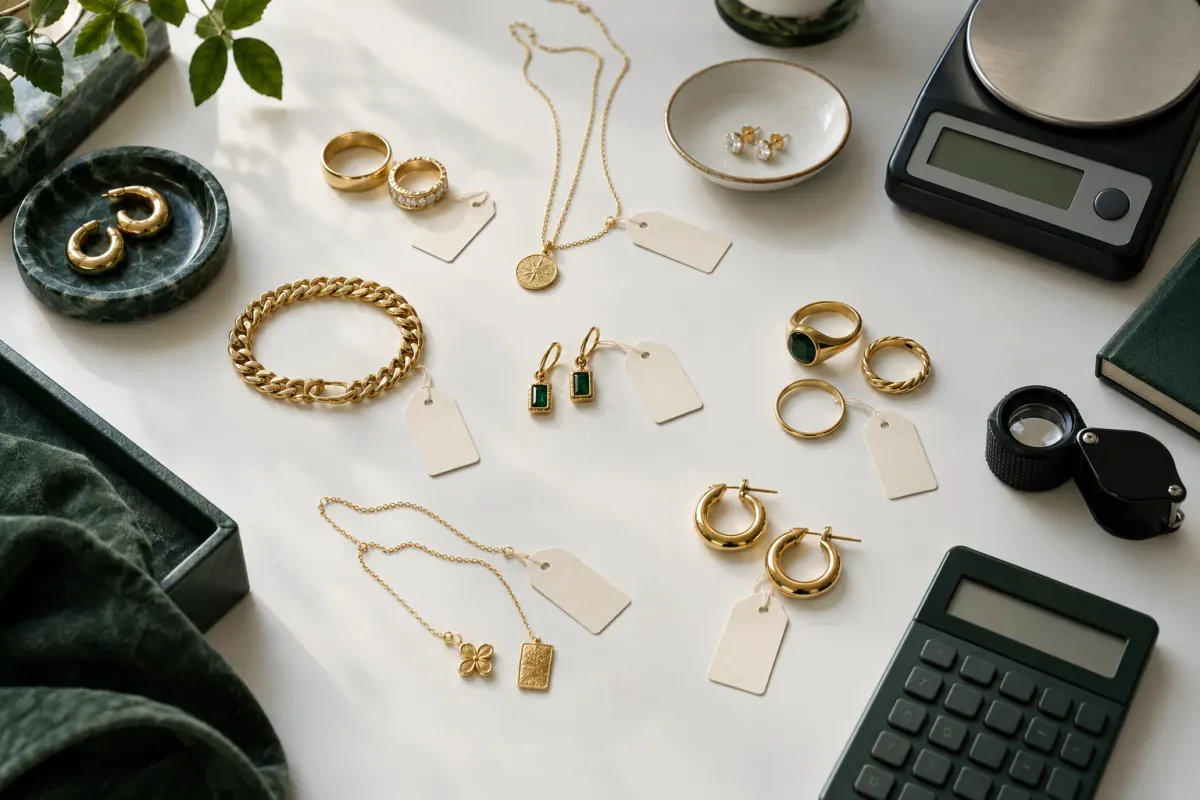
Make a simple list with columns for item, mark, gross grams, stones or non-gold parts, condition, and notes. If you have an unmarked heirloom or a piece that might be collectible, get a professional opinion before treating it as scrap. You can learn more about the role of testing and purity in our guide to how gold buyers determine value.
Have your weights and markings ready?
Share what you know with Cha-Ching Co and request a free cash offer with no obligation to accept.
Convert grams, pennyweights, and troy ounces
Precious metals use troy weight, which is different from the ordinary avoirdupois ounces used for groceries and shipping. The National Institute of Standards and Technology conversion chart lists:
- 1 troy ounce = 31.1034768 grams
- 1 troy ounce = 20 pennyweights
- 1 pennyweight = 1.55517384 grams
- 1 gram = about 0.6430149 pennyweight
For a quick conversion, divide grams by 31.1034768 to get troy ounces. Multiply grams by 0.6430149 to get pennyweights. For example, 15.0 grams is about 0.4823 troy ounce or 9.645 pennyweights. Keep a few decimal places while calculating, then round only the final estimate.
Be careful with the abbreviation "oz." A regular ounce equals about 28.35 grams, while a troy ounce equals about 31.10 grams. Using the wrong ounce can distort an estimate by almost 10 percent. Ask a buyer which unit appears on the receipt and make sure both the displayed weight and quoted rate use the same unit.
Estimate the pure-gold portion
Once you have separate gross weights, karat gives you a rough purity fraction. Divide the karat number by 24: 10K is 10/24, 14K is 14/24, and 18K is 18/24. Common rounded fractions are 41.7%, 58.3%, and 75%.
Estimated pure-gold grams = eligible gold-alloy weight x karat ÷ 24
Suppose a stone-free 14K chain weighs 15.0 grams. The simple calculation is 15.0 x 14 ÷ 24 = 8.75 estimated pure-gold grams. That does not mean a buyer will pay the full spot value of 8.75 grams. Testing tolerances, solder, non-gold components, refining loss, operating costs, market movement, and the buyer's margin can all affect an offer.
A ring that weighs 15.0 grams with a large stone cannot use the same calculation because the scale included the stone. If the stone weight is unknown, keep the reading labeled gross and ask how the buyer deducts it. Our separate guide to estimating what your gold may be worth explains the difference between theoretical metal value and a real offer.
What not to include in the gold weight
Anything that is not part of the gold alloy can inflate the home reading. Depending on the item, that may include gemstones, pearls, glass, enamel, resin, cord, watch movements, steel springs, clasps, pins, and internal supports. Some components are too difficult or risky to remove at home. Leave them in place and disclose that your number is gross.
Hollow jewelry deserves special attention. It can look large while weighing much less than a solid piece. That is not automatically a defect, but it changes expectations. The FTC guidance notes that hollow construction should be disclosed near a gold description and that such products should not be called solid gold.
Gold-filled and plated items need a different method altogether. Their full weight is mostly base metal, so multiplying the entire gram total by a solid-gold purity percentage creates a false estimate. Sort them into a separate bag and ask whether the buyer accepts that material.
Check a buyer's scale and math
Your home weight is a reference point. At the counter, ask to see the scale return to zero and watch each group being weighed. The NIST guidance says precious metals sold based on weight should use troy weight or SI units such as grams. If the buyer switches between grams, pennyweights, and troy ounces, ask for the conversion in writing.
A useful receipt or worksheet should identify each group, its tested purity, weight unit, quoted rate, deductions or fees, and net offer. If stones are removed, ask what happens to them. If the buyer melts or cuts an item during testing, understand whether the transaction becomes final before allowing it.
Compare net dollars, not just a bold percentage or per-unit number. One buyer may quote a higher rate but deduct more weight. Another may value an intact designer piece above scrap. For signed, antique, or unusually well-made jewelry, get both a jewelry-resale opinion and a metal offer before deciding.
Common weighing mistakes
- Using ordinary ounces. Gold pricing generally uses troy ounces.
- Mixing karats. A combined weight cannot be assigned one honest purity.
- Counting stones as gold. Record the number as gross when inserts remain.
- Treating a stamp as proof. Marks help with sorting, but testing may tell a different story.
- Calculating plated jewelry as solid gold. The gold layer may be only a small part of total weight.
- Rounding too early. Keep extra decimals through unit and purity calculations.
- Damaging a wearable piece. Filing, acid testing, or removing stones can reduce resale value.
Bottom line on how to weigh gold jewelry
The best home method is straightforward: use a stable gram scale, tare the tray, weigh twice, separate pieces by marking, and label any weight that includes stones or other materials as gross. Convert units with the NIST factors, then use karat only for a rough estimate of the pure-gold portion. Keep that estimate separate from the offer you may actually receive.
Bring your notes and photographs when you request quotes. Ask each buyer to show the weight, explain testing, identify the unit, and put the net amount in writing. A few minutes of careful recordkeeping makes it much easier to spot a unit error or compare two offers fairly.
Ready to compare your options?
Request a free cash offer from Cha-Ching Co and decide whether it works for you.
Disclaimer: This article provides general educational information and is not financial, legal, tax, or appraisal advice. Precious-metal prices, testing results, buyer terms, and offers change. Have potentially valuable or uncertain pieces evaluated by a qualified professional before selling.